Affichage des articles dont le libellé est beer. Afficher tous les articles

beer with a painter : Lois Dodd

interview by Jennifer Samet for hyperallergic https://hyperallergic.com/194330/beer-with-a-painter-lois-dodd/


Jennifer Samet: You grew up in Montclair, New Jersey. Were any of your family members artists?
Lois Dodd: No, but I had family members who worked with their hands. One of my father’s brothers was an architect. My grandfather made furniture and had a workshop in his backyard. I remember the atmosphere and surroundings being wonderful — it smelled good because of the wood. The floors were covered with the shavings you get from planing wood.
The Second World War was going on during the years that I was in high school between 1941 and 1945. During that period my mother developed breast cancer and died, after which my father, who had stayed home to care for her, returned to his position as a captain in the Merchant Marines. His ship was involved in the Land-Lease program. His ship was torpedoed while transporting supplies to Murmansk and only half of the crew survived. He did not. So, my parents had both died by the time I was fifteen.
In Montclair High School there was an unusually good art program. The art classroom was a double-sized room with a banana tree in a large container under a skylight. We had two teachers, one about to retire, and the other doing her student teaching stint. One day, the young teacher spoke to us about art school options in New York City. She mentioned that Cooper Union was free if you passed their test. Another classmate and I got in. I commuted in from Montclair for the three years.
JS: Who did you study with at the Cooper Union? There is a certain economy of means that is present in your work, as well as that of Alex Katz, who was a fellow student. Was there anything about the teaching at Cooper Union that might have led to that?

LD: My painting teacher at Cooper Union was Byron Thomas. He started class by teaching us to make paint. We first made water-based paint and painted with it on large sheets of brown paper, then egg tempera, and finally we ground and used oil paint. I still have the sheet he handed out with all the recipes. I think it was a wonderful introduction —to know the materials before you started using them. He sent us to Fezandie & Sperrle to buy powdered pigments. We also bought glass mullers with which to grind the pigments into linseed oil and metal tubes to fill with our ground paints.
At Cooper Union, I met Bill King, who had come to New York City intending to study architecture at Columbia. But without adequate tuition money, he enrolled at Cooper Union instead, and moved into sculpture. At the end of the three-year program Bill received a scholarship to Skowhegan and also a Fulbright fellowship to Italy. We were married between his two scholarships and I went to Italy with him at the end of 1949.
I also met Jean Cohen, who became Alex Katz’s first wife. We all were very good friends and shared property in Maine.   The friendships lasted longer than the marriages. 
JS: Can you tell me about your time in Rome — what art you were especially interested in and looking at?
LD: 1950 was a Holy Year for the Vatican in Rome but Italy was still suffering from all kinds of shortages at the end of the war. For example, there were very few cars in the streets which meant we could wander throughout the city with minimal danger of being run over as we looked for and found architectural monuments, churches, public sculpture.
We got a Moto Guzzi to enable trips to some of the hill towns near Rome. An American film, Teresa,was being made in Bologna in the spring of 1950 by director Fred Zinnemann. Our friends rushed off to take jobs in the production and Bill was included as an extra portraying a G.I. We also went to Florence, Venice, Naples, Milan, Turin, and the smaller city-states. At that time, it was the 14th Century painters that everybody loved — the flat, design quality of that work.
I did some painting in Italy, but it was more about looking at other art for the year. It was the same when I returned ten years later, in 1959, with my son Eli. When I look at the paintings that I did there, they are not really worthwhile. I am not a travel painter. It just doesn’t work for me, though I enjoy it. I work best going back to the same places. I change, they change, or the weather changes. I used to think the subject would dry up, and I would have to make a move. But that never happened; it is the reverse.
Alex Katz and Jean Cohen and Bill and I went to Lakewood, Maine, in the summer of 1951 after returning from Italy. Being in Maine is what got us all working outdoors. You get habituated to it when you realize you don’t have to be inside to be working. We opened a little gallery, the Accent Gallery, in which to show our work and other friends.
JS: By 1952, you, along with four other artists, founded the Tanager Gallery, one of the early artist cooperatives. How did that happen? You have described the experience as like getting an MFA. What do you mean by that?
LD: Bill had met Charles Cajori at Skowhegan, and in Rome we met Angelo Ippolito and Fred Mitchell, who were there on the G.I. bill. When we all returned to New York, we wanted to show our work, but we certainly couldn’t show in any uptown gallery. De Kooning and others were just beginning to show on 57th Street at that time. That is when we got the notion to open up our own cooperative gallery. The Tanager Gallery was started by me, Cajori, Bill, Angelo, and Fred Mitchell.
We rented a small storefront on Fourth Street east of the Bowery in the summer of 1952. At that time the elevated train was running up and down Third Avenue and the neighborhood was very run down. A year later Philip Pavia told Angelo there was a cheaper, bigger place on Tenth Street. Of course, it wasn’t really big compared to the size of galleries nowadays. We were in the Tenth Street space for ten years, from 1953 to 1962.
The gallery was how we met every other artist in New York City. We visited studios, deciding who to show. It was great to become part of that world. The gallery scene on Tenth Street kept growing. We were the first one on the block, but quickly there were others there and around the corner.
Altogether over the ten-year period there were eighteen members: George Ortman, Joseph Groell, Philip Pearlstein, Perle Fine, Charles Cajori, Lois Dodd, Angelo Ippolito, Bill King, Fred Mitchell, Sidney Geist, Sally Hazelet Drummond, Ben Isquith, Alex Katz, Lester Johnson, Nick Marsicano, Raymond Rocklin, Sal Sirugo, and Tom Wesselmann.
For our first one-man show we invited John Grillo. We used to have enormous Christmas shows with one hundred small paintings, hung all over the walls. De Kooning would come into the gallery. He was a major figure on Tenth Street. Milton Resnick, Pat Passlof, Al Kotin, Kenneth Kilstrom, Gabe Kohn, Lester Johnson, Philip Pearlstein, Mary Frank, and Robert Krushenick all had studios on the block at one time or another.
JS: An early body of your work was paintings of cows. Why did that become a subject of yours?
LD: I had studied textile design at Cooper Union, so I was thinking about pattern. At that time I spent summer in Lincolnville, Maine. There were a lot of cows in the area. The subject of the cows answered to that — they seemed to be in a place between pattern and representation. They made a good shape: white with big black patches.
I would go outside, find cows and draw, and use the drawings in the wintertime to paint. That kept me busy for a while. Then I did my biggest cow painting, which was 72 inches square. That was it; I wasn’t going to do any more cows.
In 1976 I moved from Lincolnville to Cushing, Maine. It is closer to the water, so there aren’t people raising cows — there are lobstermen. Either you move or the subject moves. There are endless things — the house, the road, the barn, and the landscape out in the woods.
My neighbor Leslie Land, who wrote about food and gardens, planted a large garden. It became a resource — to paint what was happening in the garden. At first, I didn’t want to get involved with it — being a woman artist painting flowers didn’t seem like a good idea. Nancy Wissemann-Widrig, who lives in Cushing as well, wasn’t put off; she did great big paintings of the garden. I thought, “I will paint Nancy painting in the garden.”
One year Leslie worked like mad to get a plant called a cow parsnip going. It is six feet tall with a gigantic flower. As the flowers are architecturally simple, I could deal with them as a subject, and from that plant, I continued to paint others.
JS: You talk about de Kooning as a major force in the New York scene of the 1950s. Did Pop Art have any impact on your work?
LD: Yes, technique-wise. The Abstract Expressionists did a lot of dripping. And then along came Pop art and they were so clean, and the edges so neat. Meanwhile what I was doing was not too related to either one. But I felt like I couldn’t be quite as sloppy as I was earlier on, because everything was getting so clean. That is Pop Art’s only influence on my work: “Clean up your act a little bit.” It wasn’t the attitude or philosophy.
I admire people that can ladle on paint — it is delicious. But I can’t do that; it’s not me. I am stingy with the paint; it is very thin. I use bristle brushes. If I used brushes that were a little softer I could put more paint on, I guess. It’s all about the technique and tools.
JS: For a long time you were part of a figure drawing group organized by Mercedes Matter in New York, and you also had a drawing group in Maine. However, most of your paintings are absent of figures. Why is this?
LD: I love drawing the figure and have been part of drawing groups in both New York and Maine. In Maine, the same model has posed outside in the sun for our group for years. It’s just lovely. I have piles of figure drawings, but I rarely use them to paint. Anytime I did, I didn’t like the result.
I enjoy drawing the model because it keeps you wide awake, making instantaneous decisions. You know she is going to move, so you have to stay very focused on what you are doing. I don’t like long, static poses. I don’t care about making a beautiful figure. I’d rather be involved with how she is moving, what she is doing. In Maine, the figures would be involved with something interesting – climbing a tree, using an axe, working. She is not just lolling there. It is more alive that way.
JS: Is it the same with the places you have painted repeatedly — that you are painting the activity and changes happening in them? In addition to painting in your home in the East Village, you also paint outdoors in Blairstown, New Jersey, near the Delaware Water Gap.
LD: Yes, landscapes are different every day, and at night. There are always events — some natural and some manmade — that take place. In “Self-Portrait in Green Window” (1971), I was interested in the window. I saw my reflection but didn’t notice the plant in front of the window until I was almost done, and considered whether I should put it in or not. I thought if I put it in, it would push the window back a bit. It gives the painting a little more space to stand.
The painting, “Ice in Window” (1982), was an amalgam, in that I was not actually looking at the river through the window. I started the landscape painting and then decided to put the window frame, from another painting, on top of that scene. I wanted to see what the two would do for each other.
Sometimes I feel like a reporter. I had been painting by the Delaware Water Gap when the river froze. There was a rainstorm and the ice got broken up and thrown onto the banks. It was amazing looking, so I sat on the bank and painted a couple of little panels. I used these for bigger paintings. The painter Marcia Clark goes to the North Pole and paints glaciers. I’m not going there, so my North Pole will have to be at the Water Gap. If I can catch some exciting natural event, it is great.
I started doing nighttime paintings in the 1970s. For some reason in Maine, in 1975, there was a minimum of mosquitoes at night. You could stand outside and the moonlight was so brilliant certain nights that I realized I could paint in it.
JS: You’ve mentioned an architectural geometry as integral to your work. Your paintings seem so direct; how do you plan out the compositions?
LD: With the window paintings, the big decision is where to put the grid. I also decide how much I can include. Even with plants there is a kind of geometry that helps — where are you going to situate the square, triangle or oval that underlies their growth pattern. Usually I draw with pale yellow on the panel, because it can disappear — it is easy to rub off with turpentine, or I can scrub it around with the turpentine. It also gives me a base color.
JS: There is a confidence and singularity that characterizes your path, especially your choice of subject matter. How have you been able to maintain this?
LD: Well, you are always influenced by the people around you. How do you find out who you are if it isn’t from other people? But painting may be the only thing in life that I’ve been confident about.
You have to have something that you don’t ask anybody else about. I’ve always been aware of that with painting. No one else can really help you, or say whether it’s good or bad. It’s just you and it, and that’s great. You can handle everything else in your life much more easily, because you have that place where you are on your own.

beer with a painter : Susan Jane Walp


Jennifer Samet: You grew up in Pennsylvania. Do you recall any specific early experiences with art making?
Susan Jane Walp: Yes, I grew up in Allentown, in southeastern Pennsylvania. My earliest memory of having a talent that was recognized was in the third grade. School was very hard for me, and at that time, I don’t remember having any friends in the school itself, although in the neighborhood I was part of an adventuresome group of kids. The class was in charge of decorating a bulletin board with a fall theme. My teacher asked me to make a hunter. It was an incredible experience. I don’t remember doing it for any kind of approval — only for the pleasure of making it — and I loved how it turned out.
The teacher really liked it too, and asked me to do a second one. This time, I had terrible anxiety. I couldn’t get it to look the way that I wanted it to. That was my first experience of what feels like a familiar pattern. Perhaps I was trying to improve the anatomy. You move forward and learn, sometimes at the expense of the inspiration, vitality, and life that come in the beginning of the process.
We were living with my grandparents at the time, and I talked my mother into allowing me to stay home to work on it. I remember working in my pajamas at the kitchen table. I was agonizing over it, but my grandmother and mother were sitting there watching in awe. They could not believe I was able to do what I was doing. My mother’s family was very musical, but they had no visual abilities. In my father’s family, there was a lot of visual talent. My paternal grandmother worked full-time at the family business, and was a very disciplined Sunday painter.
In the third grade I also started taking classes at a very old-fashioned art school in Allentown. It was a beautiful old building with north-facing skylights. It was such a different era back then. My parents would drop me off in inner-city Allentown, and I would walk down the block myself to buy snacks, then come back and buy my charcoal, paper and erasers in the school store. We drew from plaster casts of Greco-Roman sculptures. I felt like such an adult, and very special.
JS: I noticed the small altar in your studio. Does religious practice and meditation play a role in your work?
SJW: Since childhood, I have been interested in religious ideas and practice. My mother’s Austrian family was Lutheran, and I was raised Lutheran. When I was eight, I had a Sunday school teacher, the young wife of the new assistant pastor, who was discussing the idea of the Trinity. She spoke as if she were addressing a group of college students. She presented it as a mystery, as something that she herself was grappling with: how there are three different parts, and yet they are one. These are the things I most remember from childhood, the times when I was taken very seriously by adults.
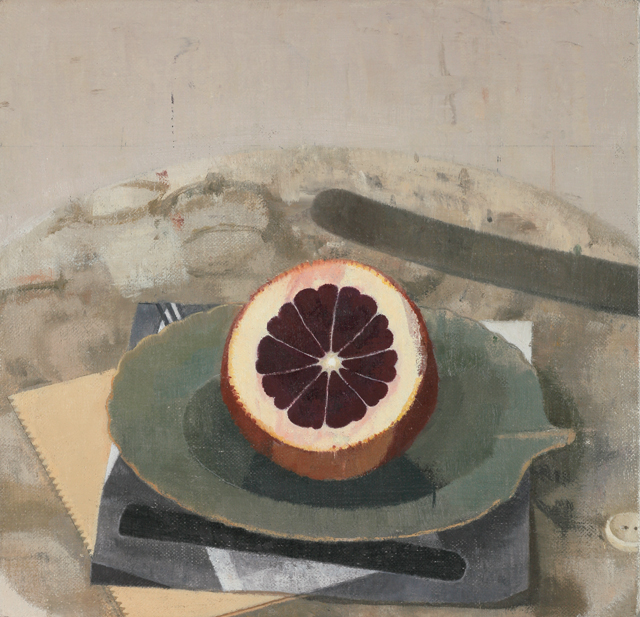
Susan Jane Welp, “Heart of Winter Blood Orange” (2010), oil on linen, 8 x 8 inches
My paternal grandmother was from a Mennonite background, and I went to a high school run by the Moravians, another Protestant group who established a religious community in Bethlehem, PA, in the early 1700s. Like the Mennonites, they were pacifists and oriented towards education and music. Their motto was “In the essentials, unity; in the non-essentials, liberty; and in all things, love.”
In New York, I became involved with Gurdjieff’s philosophy, and I had a wonderful teacher. After he died in 1983, I moved to rural Vermont with my husband, Michael Moore, and then I spent a long time looking for something. In 2006, I found my way to a recently opened Tibetan Buddhist center in a neighboring town, founded by Dzigar Kongtrul. I have been closely involved with that community for the last ten years. When I go into the studio, I usually begin with a brief meditation. It is a reminder that the inspiration for the work is not so much about me, as it is about being receptive to something that could move through me.
JS: You went to Mount Holyoke for college. Were you studying painting at that time?
SJW: I went to Mount Holyoke in the late 1960s, and there was so much turbulence. I wanted to drop out at a certain point; I was not happy there at all. I had a situation that required surgery, and I missed two and a half months of school. To make up the credits, I went to a program at Tanglewood, run by Boston University. Miraculously, Lennart Anderson was teaching there. The students from BU were very serious, and only because the beginner class was full, I was placed in Lennart’s advanced class. That summer completely changed everything. I saw that my life was going to be devoted to becoming a painter.
Lennart painted in class; he didn’t talk much. But I understood that he was teaching an approach to seeing tonal relationships. It was a very sensual, felt response to the motif. It was about discovering the beauty of these relationships and the thrill of translating them into paint. At the time, he was recommending a Dover book by Charles Hawthorne, Hawthorne on Painting (1960), which we all read and reread.
JS: You also went to the New York Studio School in the early years of the school. What was your experience there?
SJW: I was at the Studio School for about five or six semesters, both during and after Mount Holyoke. It was a wonderful and very intense experience. The daily schedule was very strict — a four-hour session in the morning, another four hours in the afternoon. And many of us continued working well into the evening. The door was locked by 9am, so if you didn’t arrive by then, you couldn’t get in. You worked until 1pm, and then there was a break for lunch. Mercedes Matter would send the kitchen team to Balducci’s for breads, salamis, cheeses, and salad ingredients, and so we had the most amazing, abundant lunches Beginning students spent all eight hours drawing from the model. Nobody spoke in the studios; everyone worked with focus and concentration. I loved the feeling of being part of a like-minded community.
The teachers came in two days a week. Initially I studied drawing with Mercedes, and then I switched over to Nicolas Carone’s class. Mercedes’s teaching was about sensitivity to neighboring relationships, with the image growing out of an accumulation of careful observations. The way that Nick taught was working in the opposite direction: first defining the limits of the plane and the space it contained, and then working from the big forms down towards the detail. Nick taught a kind of metaphysics of space that was not always easy to understand. For me it was about becoming aware of possibilities that existed beyond what one’s habitual mind could ever imagine.
Philip Guston was also teaching at the Studio School at the time. He would make the rounds, moving from studio to studio of the more advanced students, but the beginning students were allowed to follow along and listen in. He hardly ever talked about the students’ paintings! One day, he was visiting the studio at the top of the main stairs; I remember this so clearly. He had brought in a book about Piero della Francesca. I had never heard of Piero della Francesca. He spoke at length about a detail in one of the Arezzo frescoes — an image of hill town rooftops.
I understood Piero immediately — you could say it was love at first sight — and I have since spent a lot of time looking at his work, at first in books and later travelling to see the actual works in Italy and London. The elements in his paintings are so deliberately arrived at—they are spatially and mathematically measured—yet there is simultaneously a strong pattern of shapes moving across the surface. Piero trained in Florence and must have been familiar with the Florentine advances, in terms of three-dimensionality, especially the work of Masaccio
What is interesting to me is that at a relatively young age he returned to his hometown of San Sepolcro, a place that was isolated from Florence and whose church art was influenced by the flatter, more stylized qualities of Sienese art because of trade routes. He chose to retain these qualities that came more from the early Renaissance, even though he could have gone in the direction that eventually led to Leonardo and Michelangelo. The other thing I have found so compelling in his work is how a certain restraint actually intensifies the emotions.
I also remember sitting in the library of the Studio School and looking at a Morandi book. Leland Bell came in and launched into a diatribe, saying I shouldn’t be wasting my time with Morandi. I was fond of Leland and was aware even then that his strong opinions came from how passionate he was about painting and wanting to share that with students. After he left the room, and I started looking at the book again and thought to myself, “I don’t agree with him.” This seemed momentous to me. For the first time it felt like I had confidence in my own mind, and no one was going to talk me out of my inspirations and responses. And I still do love Morandi’s work.
I have gravitated to painters who have lived in provincial settings, like Morandi and Piero. I’m very interested that Agnes Martin moved to an isolated place. Georgia O’Keeffe is another example. I have always been interested in a solitary life, and what that means for an artist who also wants to be part of her time and era. I think, if they could do it, so could I.
JS: I read that you begin paintings in relation to the cycles of the moon. That is fascinating; I have never heard another painter speak of doing this. Can you tell me more about it?
SJW: My Austrian grandmother grew up on a farm and taught me about planting seeds with the phases of the moon. You plant things that grow above ground with the new moon, and things that are harvested for the root, with the full moon. At some point, perhaps after I moved to Vermont and had my own garden, my friend, the painter Helen Miranda Wilson, told me she had been using the cycle of the moon in relation to starting and finishing paintings. I tried it out, and it appealed to me.
With the new moon, which is good for beginnings, I work on finding the motif, painting very freely and openly, trying to get the big gesture and structure of the composition. With the full moon, which is good for completing things, I shift to the fine detail work. When I started working this way, it took away a lot of frustration and confusion. It simplifies things: there is a time for different kinds of activities.
JS: Your still lifes contain certain recurrent objects — blueberries, halved citrus fruits, teacups, and other vessels. Do those objects carry certain personal meanings or significance to you?
SJW: The objects do play a role, but the only way to allow them to truthfully manifest is by seeing them in relationship to all the other elements in the picture. Sometimes, after a painting is complete, meanings are revealed to me. But if my mind moves toward a narrative as I set up the objects, I would resist that.
The thing about working from observation is how abstract it is. We live in a world where we are constantly labeling things and keeping them separate: there is the tree, the fence, and the lawn. But when you get into the painter’s mind, the labels drop away. You are seeing how interconnected everything is, through color and light and space. It is a very wonderful place to be.
A main thing for me is the setting up: arranging and rearranging the objects and waiting for things to come together as an image. With the new moon, this seems to happen reliably. That is the inspiration, and I wait for that moment. I can’t start a painting unless I have that huge feeling of inspiration from the motif. It is very specific; I feel it in my body.
JS: What kind of measuring do you do, as you compose and plan the paintings?
Susan Jane Walp, “Late Summer Berries” (2009), oil on linen, 8 x 8.25 inches
SJW: You could say I am obsessed with measuring. Once the image is there, I want to get as close as possible to the feeling that I have about the motif. At first, I don’t measure at all. The beginnings are very free and spontaneous, and often I will get very accurate measurements intuitively. But nevertheless, for the coming weeks, I measure and re-measure, and draw and redraw. I am not only measuring the forms; I am also measuring the tones, and trying to bring them into a harmony. One might think it is cold and mathematical, but for me it is a very sensual experience.
The big underlying mystery that carries me forward still is how we have this three dimensional experience with the world, and how we put that onto the flat plane of the painting. I have a picture in my mind of how I want that to look in my paintings, and I hardly ever have gotten there. But I still hope that someday I will make a painting that will satisfy me in terms of finding that relationship.
I feel I have always wanted to understand more how shadow and light create form. It hasn’t been very present in my painting, in part because I set up the motif with an even, north light. The light illuminates the form, but it’s subtle, not dramatic. The dramatic use of light and dark to create form is something that has interested me in Euan Uglow’s work. He painted a lot at nighttime, so he had a directional artificial light, which clearly defined areas with beautiful cast shadows that carry so much feeling.
Recently I read something about Morandi that I found to be a revelation. Early in his career, in terms of the other artists he looked at, he really studied chiaroscuro. But in his paintings, as they developed, there is no chiaroscuro, almost the opposite. Everything is bathed in even, inner, mid-tone light, without shadows. And yet that deep knowledge of light and dark is somehow there in the work.
I bring this up as an example of new territory I want to explore. This is the way I have moved forward: responding to these kinds of questions. I am imagining that someday I will set something up and recognize this quality of light and dark I am looking for, because of an Uglow painting that I can’t get out of my mind, or because of a passage I read about Morandi.
Something will trigger a question, and it can take months for me to even articulate it, and more months or years to figure it out. But I feel that conceptual groundwork is so important. As human beings, thinking about things, figuring them out, and putting them into language is central to us. How does that work with this other part of being a painter, which is without language, and without thinking?